
How Aspect Works in Russian
Understanding verb aspect is one of the most important steps in learning Russian. Aspect shows how an action happens — whether it is complete or ongoing. English does not have a direct equivalent, so let’s break it down.
The Basic Idea of Aspect
Russian verbs come in two aspects: Imperfective and Perfective.
The imperfective aspect describes an action in progress, a repeated action, or an action without focusing on the result.
The perfective aspect shows a complete action, a finished event, or a “one-time” action with a clear result.
Examples:
- читать — “to read” (imperfective: the process of reading)
- прочитать — “to read completely, to finish reading” (perfective: the result)
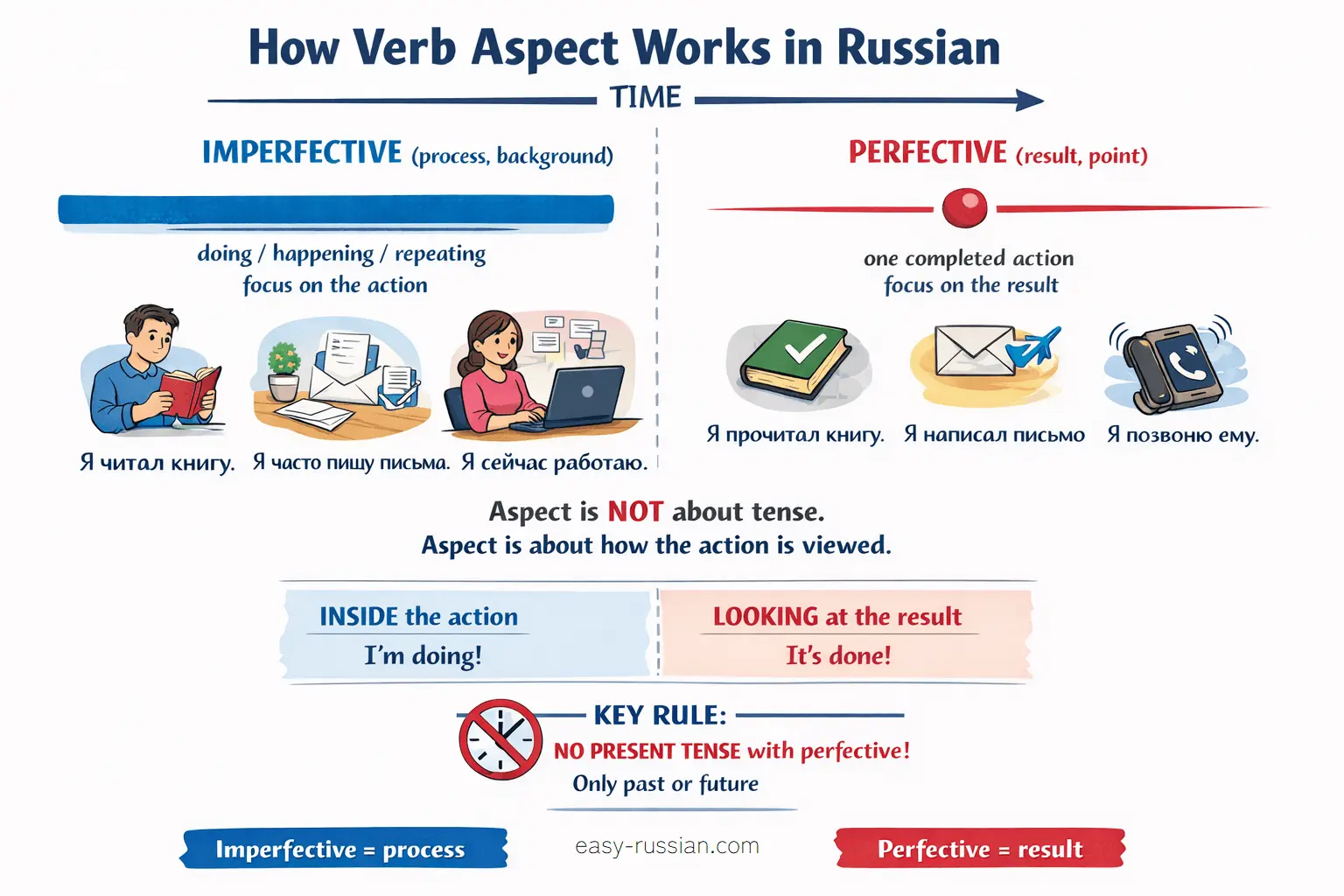
Why Russian Needs Aspect
Aspect allows Russian to express time and meaning through the verb itself.
If you say я читаю, people know you’re in the process.
If you say я прочитаю, people know you will finish it.
Even simple everyday actions become clearer with aspect.
For example, я покупаю means you are buying something right now or you buy it regularly.
But я куплю means you will buy it once and complete the action.
📚 If you’d like a clearer and more detailed explanation of Russian aspect, you can find it in my book. It walks through the logic of imperfective and perfective verbs step by step and then shows how they work in practice with 50 real verb pairs and natural examples.
Imperfective Aspect: The Action Itself
Imperfective verbs are used for:
- the action is ongoing,
- the action is repeated or habitual,
- you talk about the action in general, without focusing on the result,
- the action was not finished (or finishing is not important).
You use imperfective when you focus on the activity, not the end point.
You can use it in:
- present
- past
- future
👉 Recommended reading: 100 Verbs For Intermediate Russian Learners
Examples:
Я читаю книгу. Не отвлекай меня.
I am reading a book. Don’t distract me.
Я читаю по вечерам.
I read in the evenings.
Завтра я буду читать весь день.
I’ll be reading all day tomorrow.
Вчера в семь вечера я читал книгу.
I was reading a book at 7 p.m.
Я весь день читал книгу и не заметил, как прошло время.
I was reading a book all day and didn’t notice how the time passed.
Да, я читал эту книгу — я знаю, о чем она.
Yes, I’ve read this book before — I’m familiar with it.
The action doesn’t need to be finished. That’s why the imperfective is more flexible and appears in many everyday contexts.
Summary: Imperfective describes ongoing, repeated, or general actions.
Perfective Aspect: The Finished Event
Perfective verbs describe completed actions — things with a clear beginning and end.
They often answer the question: “Did the action reach a result?”
You can use it only in past and future.
Examples:
Я прочитал книгу.
I finished reading the book.
Я прочитаю книгу на выходных.
I will read the whole book this weekend.
Я куплю хлеб.
I will buy the bread.
Она сделала работу.
She completed the work.
The perfective aspect is not used for actions happening right now, because “right now” usually means the action is not finished yet.
Summary: Perfective shows a complete, one-time, result-oriented action.
Aspect Pairs
Most Russian verbs come in pairs: one imperfective, one perfective.
Examples:
- делать / сделать — to do
- писать / написать — to write
- готовить / приготовить — to cook
- продавать / продать — to sell
- находить / найти — to find
- брать / взять — to take, to borrow
Most of the time the perfective verb is created with a prefix (написать) or the form changes (открывать → открыть), and sometimes it just looks different (говорить → сказать). You learn the pair as two forms of the same meaning.
👉 See Also: Russian Verbs of Movement
Let’s compare the common verb pair делать (imperfective) and сделать (perfective). Both mean “to do / to make,” but they show different views of the action.
Imperfective: делать — focus on the action
Use this form when you talk about the activity itself, repetition, or the process.
Present:
Я делаю домашнее задание.
I am doing my homework.
Past:
Вчера я делал домашнее задание.
I was doing my homework yesterday.
Future:
Завтра я буду делать домашнее задание.
I will be doing my homework tomorrow.
Perfective: сделать — focus on the result
Use this form when the action is completed or you emphasize the finished result.
Past:
Вчера я сделал домашнее задание.
I did (and finished) my homework yesterday.
“Present” form (future meaning):
Завтра я сделаю домашнее задание.
I will do (and finish) my homework tomorrow.
Verbs Without an Aspect Pair
Some verbs do not have a natural aspect pair. They exist only in one form and do not normally form a perfective – imperfective counterpart.
This usually happens for semantic reasons: the meaning of the verb itself does not easily fit the idea of a completed vs. ongoing action.
Verbs That Exist Only in the Imperfective Form
Many verbs that describe states, abilities, or ongoing conditions exist only in the imperfective form. Since these meanings are not naturally viewed as a completed result, Russian does not usually create a perfective partner.
Examples include:
- существовать — to exist
- принадлежать — to belong
- зависеть — to depend
- содержать — to contain
- иметь — to have
These verbs describe a state rather than an action, so the idea of “completion” usually does not apply.
Example:
Этот дом принадлежит моей семье.
This house belongs to my family.
There is no perfective verb meaning “to finish belonging”.
Verbs That Exist Only in the Perfective Form
Some verbs exist only in the perfective form because they describe a single sudden event or a momentary action.
Examples:
- очнуться — to regain consciousness
- вздрогнуть — to shudder / start suddenly
- опомниться — to come to one’s senses
- грянуть — to burst out (about thunder, applause, music)
These verbs already imply a single completed moment, so an imperfective version usually does not exist.
Verb aspect is the system Russians use to express how an action happens. You have two options — imperfective (the action itself) and perfective (the finished action). Once you start seeing verbs as pairs and asking “process or result?”, you will understand Russian much more clearly.
